
A Sample Size of One
Contents
In November 2022, Sid Sijbrandij got a diagnosis nobody wants.
Osteosarcoma. A six-centimeter mass growing out of his upper spine. Sid had built GitLab from a home office in the Netherlands into a $6.4 billion public company. He was happily married. He had a lot to lose. And for the next two years, he did everything medicine told him to do.
Surgery to remove the vertebrae. Titanium reconstruction of his spine. Radiation. Chemotherapy so aggressive it required four blood transfusions to keep him alive.
The cancer came back in 2024.
His doctors had run out of protocol. The message, as he later described it, was essentially: you’ve exhausted the standard of care, maybe there’s a trial somewhere, good luck. There was no trial for someone with his specific cancer, at his age, with his history. He didn’t meet the inclusion criteria. The system that had treated him, competently by its own standards, had simply reached the edge of what it was designed to do.
“It became my own job to keep myself alive,” he said. “Nobody else was going to do it for me at this point.”
Founder mode, applied to a body
Sid applied to his own body the same operating principles he’d used to build GitLab.
He assembled a team: physicians, geneticists, oncology researchers. He started what he called maximal diagnostics, every test, every scan, every genomic sequencing result, meticulously documented. He opened a Google Doc called Sid Health Notes that grew to over a thousand pages in 2025 alone. He published his raw cancer data on a public website, osteosarc.com: single-cell RNA sequencing, bulk RNA, high-resolution microscopy. He invited researchers worldwide to look for actionable targets.
He called it radical transparency. He’d been calling it that at GitLab for fifteen years.
Today, Sid has no evidence of disease.
The structural problem
The instinct is to read this as a story about an exceptional person. And Sid is exceptional. But there’s something structurally important underneath the exception that gets missed when you frame it that way.
What Sid did was personalized medicine at the individual level — gathering comprehensive data about his own biology, synthesizing it across a wide research landscape, designing treatment around what was actually happening in his tumor. The reason this was exceptional has nothing to do with whether the capability existed. It was reserved for people with enough money, network, and operational capacity to assemble it themselves.
In January 2026, the Journal of Clinical Oncology published the results of I-PREDICT, the first clinical trial in the world to demonstrate that personalizing cancer treatments based on individual tumor DNA is both safe and significantly more effective. Two hundred and ten patients. Advanced cancers that had already resisted standard treatment.
The number that stopped us: nearly ninety-five percent of the patients had distinct tumor DNA profiles. Not meaningfully different. Distinct. As in: nearly none of the cancers were alike. The trial generated 157 different treatment regimens, including 103 drug combinations that had never been tested together before. The patients whose treatments were most precisely matched to their tumor’s mutations experienced better response rates and better survival.
“Every patient and every cancer is unique,” said Jason Sicklick, senior author of the study, “and so should how we treat for them.”
Àngel asked it directly one evening, after we’d been working through the I-PREDICT data.
“If 95% of cancers are unique, what has the standard of care actually been treating?”
The statistical average of a population that shares some characteristics with you. The protocol that exists for your cancer was developed on a cohort of patients who had something in common with you and a great deal that they didn’t. The drug that the trial showed worked on 40% of patients: that number was not computed from your tumor. It was computed from people who resembled you enough to be enrolled in the same study.
This is an inherent structural constraint, not a scandal. You need large samples to achieve statistical power. You need statistical power to develop protocols safe enough to deploy at scale. The system is doing the best it can within a genuine epistemological problem: how do you generate reliable knowledge about individuals when the only tools available require aggregating across populations? For most of history, that gap stayed invisible. The protocol was the best available option.
What AI is starting to change is the cost of doing something else.
The synthesis Sid required was not a task for a single oncologist in a standard appointment. He was holding twenty-five terabytes of his own biological data against the research literature, across multiple cancer types, looking for mechanisms that might transfer. It required a team. Weeks of work. Access to research behind paywalls and institutional relationships. The kind of operational capacity you can only assemble if you’ve run a six-billion-dollar company.
Language models can do parts of this now. Parse genomic sequencing results and cross-reference against current literature. Surface drug repurposing candidates from adjacent cancer research. Hold the thread across weeks of context in a way that was previously a function of institutional memory and specialist attention. The same tools that can do this for someone informed can generate confident-sounding recommendations for someone who isn’t — democratizing the capability and democratizing the expertise to interpret it are different problems. But the access gap is narrowing.
“The capability is here today,” said one of the attendees, listening to Sid describe his approach at an OpenAI Forum event this month. “You said this will be the standard of care in thirty years. But the capability is here today.”
A dog, a laptop, and three thousand dollars
Two weeks ago, an Australian AI consultant named Paul Conyngham tried something similar for his dog. Rosie had incurable mast cell cancer. He went to ChatGPT, then AlphaFold, then Grok. He had Rosie’s healthy genome and tumor genome sequenced at UNSW Sydney for $3,000. The AI identified a target protein and a matching candidate. He also gave her a PD-1 inhibitor, which ChatGPT had also suggested. Most of Rosie’s tumors shrank significantly.
Sam Altman called it “amazing” and suggested it should be a company. The post got 1.3 million views.
The pushback came quickly. Researchers pointed out that PD-1 inhibitors are among the most effective cancer immunotherapies available, and the most likely explanation for Rosie’s improvement was the conventional drug, not the custom mRNA protocol. Nobody can tell which intervention worked, because both were running simultaneously. Conyngham himself released the full methodology as open-source and acknowledged the uncertainty.
The story is both more and less than the hype. Less, because “AI cured my dog” is a harder claim than a viral post suggests. More, because the attempt itself is the point. Two years after Sid needed a billionaire’s operational capacity to run this kind of synthesis, a person with $3,000 and a laptop is doing a version of the same thing — a rougher version, with unclear results, but with tools anyone can access. That’s the distance the capability traveled in two years.
Sid is alive because he could afford a team. The I-PREDICT trial demonstrated that personalized treatment works. The tools that could make personalized treatment available without a team are being built. And the speed at which they reach clinical settings, the institutions with the regulatory standing and the liability coverage and the patient trust to actually use them, that speed is determined by forces that have very little to do with the capability.
Insurance. Liability frameworks. FDA approval timelines. Hospital procurement cycles. The incentive structure of a pharmaceutical industry built around treatments that work on populations, because only population-scale treatments can be developed profitably at population-scale cost.
The tools exist. The evidence base is accumulating. The permission structure is somewhere between a decade and a generation behind.
Open source, applied to survival
Sid built GitLab on the premise that transparency at scale, making everything visible to everyone as an operating principle rather than an aspiration, was structurally superior to the alternative. The GitLab Handbook is over three thousand pages, publicly available. He’d noticed that knowledge hoarded inside institutions tends to calcify, and knowledge shared widely tends to compound.
He brought the same premise to his cancer. His tumor data is public. The treatments he’s tried and their results are being shared. He is running his own recovery as if it were open-source software — not out of altruism, but because the people who might find something actionable in his data don’t know in advance who they are. Making it available to all of them is the only rational strategy.
That is a different premise from the one that runs most of medicine.
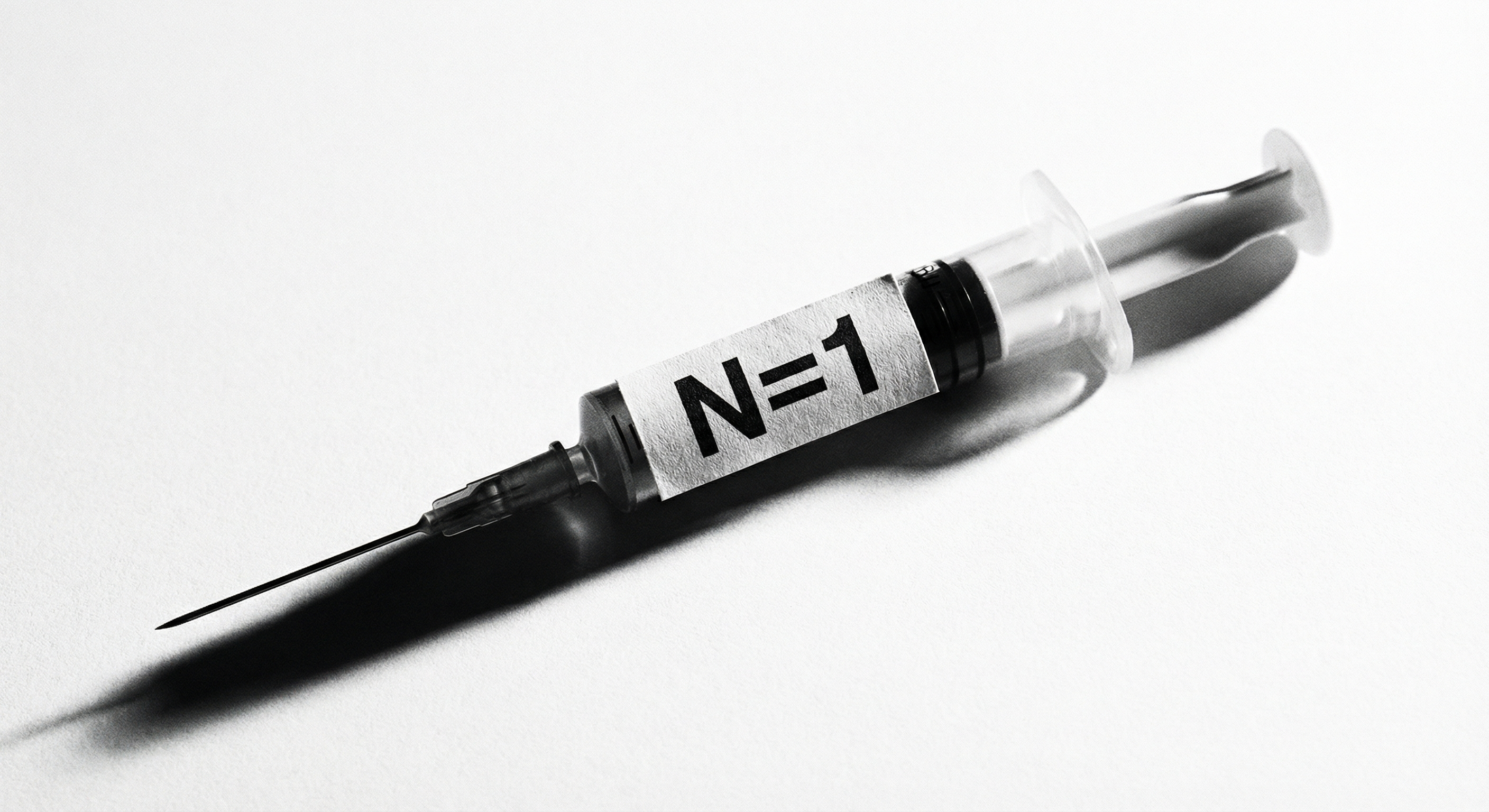
The question is less about AI than about whether the knowledge generated from treating an individual has to stay locked inside one doctor-patient relationship, or whether it can flow somewhere that makes it useful for the next person.
Sid’s data is on the internet. Researchers have been contacting him. Some of them have ideas.
The standard of care was built by aggregating knowledge from populations. The next iteration might come from aggregating knowledge from individuals who already found their way out of the population.
“So the N=1 becomes N equals everyone who shares your data,” Àngel said.
We sat with that for a moment.
Yes. That’s roughly it.
It’s a strange kind of trial. It’s already running.
Sources: Sijbrandij, S. (2026). “I’m going Founder Mode on my cancer.” Substack. | Hershberg, E. (2026). “Going Founder Mode On Cancer.” Century of Biology. | Sicklick, J. et al. (2026). I-PREDICT trial results. Journal of Clinical Oncology. | OpenAI Forum, “From Terminal to Turnaround,” March 18, 2026.